
I used to think those Salespeople Outside Shops were Annoying… Until I realized they were teaching me a million dollar Marketing Lesson.
A few years ago, I travelled with my family to another city.
Every place has its own culture.
One evening we were walking through a street filled with restaurants.
Something caught my attention.
Almost every restaurant had one or two staff members standing outside.
They weren’t cooking.
They weren’t serving food.
They were simply talking to people passing by.
“Sir… Please have a look.”
“Family restaurant…”
“Fresh food…”
“Best local food…”
To be honest…
Sometimes it felt a little irritating.
Sometimes it felt too salesy.
But something interesting happened.
Many travellers—including us—ended up entering one of those restaurants.
A few months later, I noticed something similar outside a fashion store.
A salesperson wasn’t waiting inside.
She was standing outside the entrance, greeting nearby shoppers and inviting them in.
Last year, I even saw real estate representatives explaining new residential plots to people walking on the roadside.
Different businesses.
Different industries.
But exactly the same strategy.
- Some educate.
- Some entertain.
- Some annoy.
Some simply make people aware that they even exist.
But almost all of them succeed at one thing.
They grab attention before customers walk away.
Then a question suddenly came into my mind.
Those restaurants, stores, offices, already had beautiful interiors.
- Professional signboards.
- Great lighting.
- Well-designed seating.
- Experienced staff waiting inside.
So why keep someone standing outside the entrance?
The answer is surprisingly simple.
Because people connect with people.
Imagine you’re planning to buy a car.
Two showrooms stand next to each other.
The first one has attractive banners, beautiful lighting and a glass entrance.
Nobody welcomes you.
The second showroom looks almost identical.
But someone smiles and says,
“Welcome. Feel free to come inside.”
Which showroom are you more likely to enter?
I think most of us already know the answer.
And that’s exactly what reminded me of today’s AI launch called CastAI.
Instead of placing a real salesperson outside your business…
…it places a digital spokesperson on your website or sales page.
The Interesting Idea Isn’t AI…
It’s Human Psychology.
This launch isn’t interesting because it creates AI avatars.
We’ve already seen hundreds of avatar tools.
The interesting part is where those avatars live.
Instead of publishing another talking-head video on YouTube…
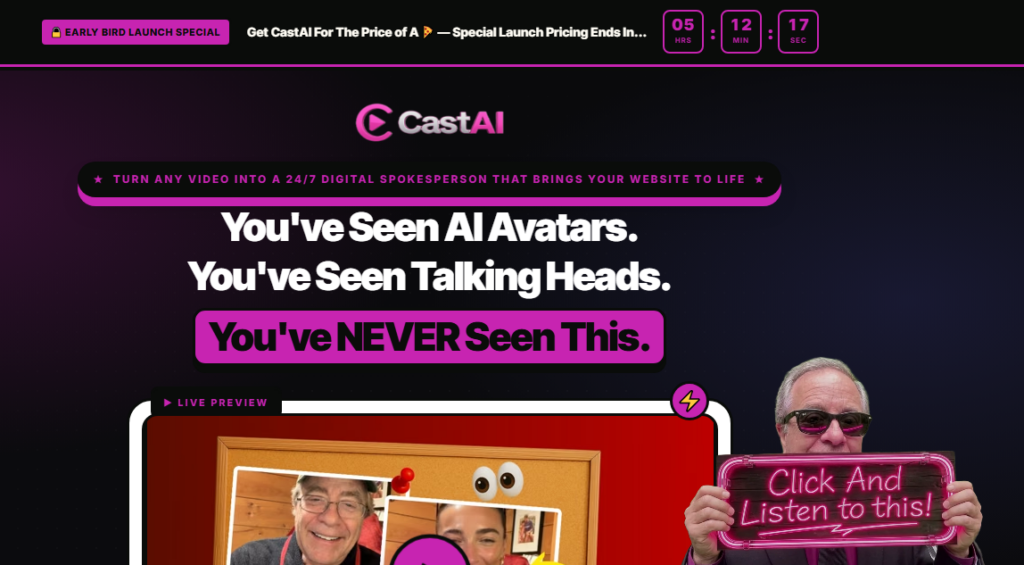
CastAI lets you embed that presenter directly onto a landing page or website as a floating digital spokesperson that can greet visitors, explain an offer and guide them toward the next step.
The platform combines two main functions:
- transforming an existing talking-head video into different presenters and
- deploying that presenter as an interactive website overlay.
That changes the conversation.
What Exactly Is CastAI?
In simple words, CastAI lets you add a talking digital spokesperson to your website.
You can either create a completely new AI avatar or even clone yourself, so visitors see a familiar face the moment they land on your website, landing page, or sales page.
Instead of reading long blocks of text, they can watch a spokesperson introduce your business or explain your offer.
The platform also lets you change the avatar’s face, outfit, voice, or even update the script later without recording the entire video again. Once everything is ready, you simply embed it on your webpage as a floating talking presenter.
(And you don’t need to code, or design anything. Just copy-paste a 2-3 liner code into your website. That’s it!)
Think of it this way.
Instead of leaving your website to welcome visitors on its own…
…you’re placing a friendly digital salesperson at the front door.
How Does It Actually Work?
The workflow is surprisingly straightforward.
- First, you upload an existing talking-head video.
- Then you can change the presenter’s appearance, clothing, voice, or even edit the script without recording everything again.
- Finally, the software generates an embed code that places the finished spokesperson on your website, where it can greet visitors and include clickable calls-to-action.
From a business owner’s perspective…
it’s closer to installing a live receptionist than uploading another promotional video.
Where I See The Real Business Opportunity
This is the part that interested me most.
Not everyone needs an AI avatar.
But many businesses could benefit from someone welcoming visitors online.
Think about businesses like:
- Restaurants
- Hotels
- Realtors
- Gyms
- Clinics
- Coaches
- Local service providers
- SaaS companies
- Course creators
Many already spend thousands building beautiful websites.
Yet those websites remain silent.
Imagine offering a service where you create a customised digital greeter for their homepage.
Not a chatbot.
Not a popup.
A branded spokesperson introducing the business, answering common questions, highlighting an offer and directing visitors toward booking, calling or purchasing.
That’s a much more interesting B2B service than simply saying,
“I’ll make AI videos.”
One Creative Online Business Idea
If I were starting from scratch today, I probably wouldn’t sell “AI avatars.”
I’d sell something like:
Get Digital Receptionist On Your Website, That Works 24/7 Without Any Salary
A local business sends me:
- their logo
- website
- offer
- basic script
I create a personalised digital spokesperson, embed it on their homepage, test it on mobile and desktop, and charge a one-time setup fee with optional monthly updates.
The client isn’t buying software.
They’re buying a better first impression.
That’s a much easier value proposition to explain.
Is There Really A Market For This?
Personally…
I think yes.
Not because every website needs one.
But because businesses constantly look for small ways to increase engagement without rebuilding their entire website.
Just as physical stores hire someone to greet customers…
some websites may experiment with digital greeters.
Whether that improves conversions depends on the audience, the script, the design, and how naturally it’s implemented—not simply because AI is involved.
Pricing & Upgrades of CastAI
During its launch, CastAI starts at $22 for the Core version, which focuses on video transformation.
The Full version costs around $25 and adds website deployment, multiple built-in spokespersons and unlimited website embeds.
For users needing more capabilities, there are several optional one-time upgrades, including HD rendering with multilingual support ($67), an expanded library of over 100 spokespersons with custom face uploads ($67), additional credits ($77), and a discounted Fast Track bundle that combines multiple upgrades into one package.
A Few Downsides of CastAI, I Couldn’t Ignore
Every interesting idea comes with trade-offs.
1. The first one is user experience.
A first-time visitor may find a talking avatar creative, memorable or even helpful.
A returning visitor who has already heard the same introduction ten times may simply find it distracting.
So I wouldn’t put one on every page.
I’d use it strategically.
2. The second concern is page speed.
Interestingly, while writing this article, it’s raining outside my home.
The internet connection is slower than usual.
It reminded me that every extra interactive element added to a webpage increases the amount of content a visitor’s browser has to load.
If your landing page becomes noticeably slower because of heavy media assets, some visitors may leave before they even see the presenter.
That doesn’t automatically mean CastAI causes unacceptable slowdowns—it will depend on how the widget is implemented, the visitor’s device, network conditions, and the overall page design—but it’s something I’d test carefully before deploying it widely.
My Final Thoughts About CastAI
I wouldn’t buy CastAI because someone promises “AI Avatars will make money for me.”
I’d buy it only if I genuinely wanted to experiment with a new way of welcoming website visitors—or if I planned to package that capability into a service for businesses.
The software may evolve.
Competitors will certainly appear.
But the underlying idea feels much bigger than one product.
People have always responded better to people than to empty storefronts.
Whether that storefront is on a busy street…
or inside a browser window…
…the psychology hasn’t changed much.