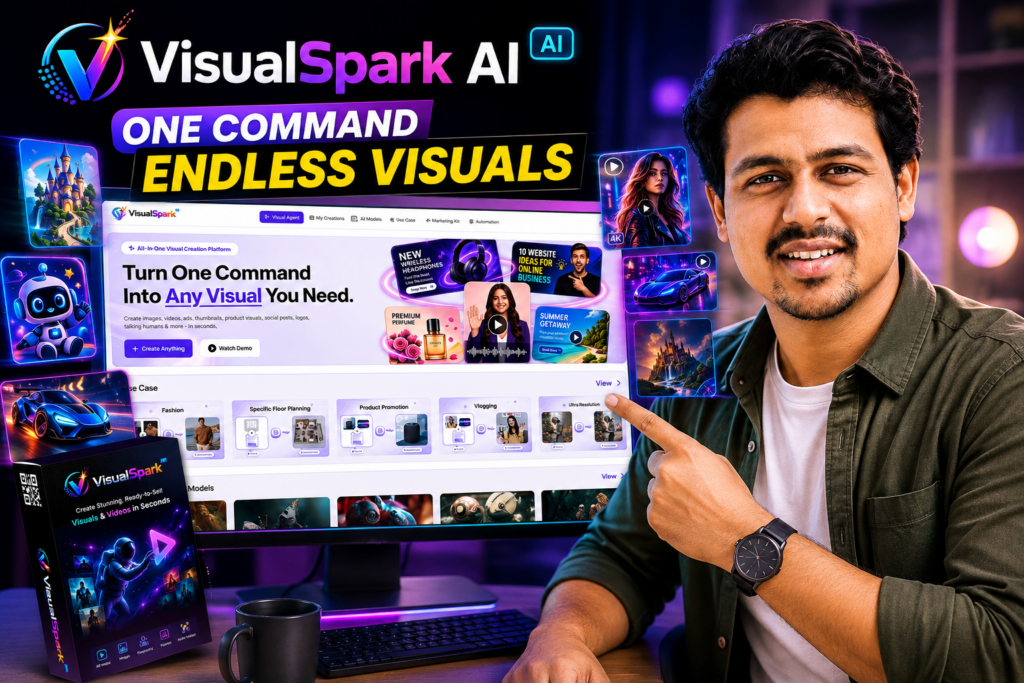

There was a time when creating a cinematic video meant having a camera, lights, editing software, a decent laptop, and probably a little patience.
Today, you can type a few words into an AI tool and get a cinematic scene, a talking character, a fashion video, a fantasy world or even a product advertisement.
So, can anyone can become a pro artist? Not really!
Everyone Wants AI Videos. But The Opportunity Isn’t Just In Making Them
I think we are living through a strange phase of the internet right now.
People are watching AI-generated characters, impossible fashion shows, cinematic mini-stories, fantasy scenes, talking avatars, surreal transformations and short visual experiments simply because they are interesting enough to stop the scroll.
And the numbers around short-form video explain why this opportunity is worth paying attention to.
Meta’s 2026 research says 97% of surveyed Indians watch video on its platforms daily, while 89% of Gen Z respondents engage with Reels every day. Fashion and trends, beauty, lifestyle, comedy and sports are among the highly engaged categories. Reels is also increasingly involved in product discovery and purchase decisions.
That’s a pretty big playground.
And it isn’t limited to Instagram.
YouTube Shorts, Facebook Reels and other short-form platforms have created an ecosystem where a simple 20-second idea can potentially reach thousands—or occasionally millions—of people.
But here’s the interesting part.
You don’t necessarily need to become a filmmaker.
You could create a page around futuristic fashion.
Another around AI-generated fantasy stories.
Another around cinematic mini-scenes.
Another around strange creatures and imaginary worlds.
Or you could create visual content for businesses—product videos, social media ads, promotional graphics, mockups, UGC-style advertisements and more.
A 2025 HubSpot study found that short-form video was one of the most common ways marketers were already using generative AI, alongside AI-generated images and other visual content.
So yes, there is an opportunity here.
But there’s a catch.
Creating AI content is becoming easier. Creating GOOD AI content is still surprisingly difficult.
And that’s where most beginners get stuck.
The Problem Isn’t Getting AI. The Problem Is Getting AI To Understand Your Imagination
This is something I think many AI beginners discover the hard way.
You have an idea in your head.
Maybe you’re imagining a futuristic fashion show where models walk through a neon-lit Mumbai street during a thunderstorm.
You type something into an AI tool.
And then…
The model gives you something that technically follows the prompt but looks nothing like what you imagined.
The outfit is wrong.
The camera angle is weird.
The character doesn’t look consistent.
The background isn’t what you wanted.
The movement feels unnatural.
So you change the prompt.
Then change it again.
Then again.
Suddenly, you aren’t creating content anymore.
You’re learning how to talk to an AI model.
And that’s a skill in itself.
The problem becomes even bigger when you start combining different tools.
- One tool for images.
- Another for image-to-video.
- Another for talking avatars.
- Another for cinematic video.
- Another for editing.
- Another for upscaling.
- Another for removing objects.
- Another for creating a product mockup.
Before you know it, your “simple AI content page” has turned into a small software-management company.
And then there are credits.
Tokens.
Monthly limits.
Different pricing plans.
Different interfaces.
Different prompting techniques.
That’s precisely the problem VisualSpark AI is trying to attack.
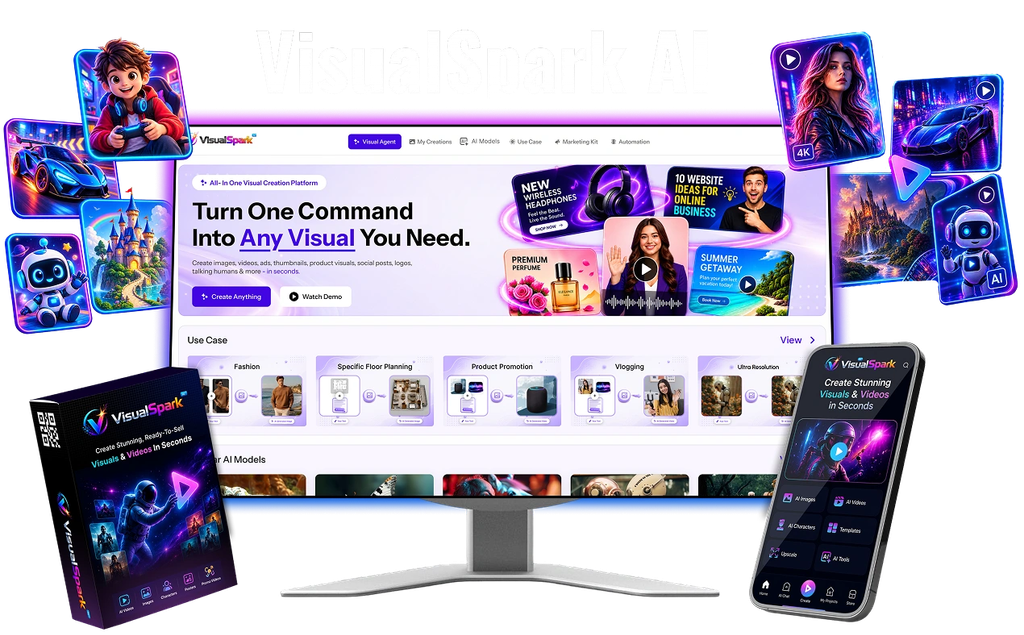
The idea is to put more than 100 AI visual models and multiple visual-generation capabilities inside one platform, with a Visual Agent that can take a simple command and handle the creation process.
It also has a built-in prompt library, which could be particularly useful for people who know what they want to create but aren’t very good at writing prompts.
And there’s one feature here that caught my attention more than all the fancy model names.
You can create all the visuals from your phone through Telegram.
That changes the equation for someone who doesn’t always have access to a laptop.
So, What Exactly Is VisualSpark AI?
Think of VisualSpark AI as an AI visual studio that tries to put a whole toolbox under one roof.
It brings together 100+ AI models and capabilities, including models/tools such as Google Veo 3.1, Imagen, FLUX, DALL·E, Midjourney, Leonardo, Runway and Kling, along with other specialized models.
The important thing isn’t really the giant list of model names.
It’s what you can potentially do with them.
You can create text-to-image visuals, text-to-video clips, image-to-video animations, image-to-image variations, talking visuals, AI avatars, product visuals, fashion transformations, cinematic clips, 3D artwork, different visual styles and more.
There are also features for things such as background removal, object removal, image upscaling, outfit changes, multi-view generation and transforming ordinary photographs into different artistic styles.
But the workflow is probably the more interesting part.
- You give it your idea.
- VisualSpark AI is supposed to select the appropriate model for the job.
- It generates the visual.
- Then you can download it, publish it or use it commercially.
It is simply idea → AI creation → use/share/sell, while the Telegram integration means the creation process can start from a phone rather than requiring a desktop workflow.
That makes VisualSpark particularly useful for someone who wants to experiment with several visual content pages.
The launch offer is priced at $17, and the coupon VISUAL2 gives $2 off for this offer.
Imagine this:
You are sitting somewhere without your laptop.
An idea suddenly hits you.
“What if I create a futuristic Indian princess walking through a floating city?”
Instead of saving the idea for later, you can potentially send the command from your phone and start creating.
That’s a very different workflow from sitting down for two hours every evening just to make one Reel.
Of course, there’s an important distinction here.
I wouldn’t interpret “one command” as “one command will magically produce a perfect viral video every time.”
The quality of the final result will still depend on the idea, the model, the creative direction and sometimes iteration.
But reducing the number of tools, interfaces and prompting headaches is genuinely useful.
Here’s How I’d Actually Use VisualSpark AI
I wouldn’t start by creating ten random AI pages.
That’s the easiest way to create ten empty pages.
I’d start with one visual theme and one repeatable content format.
For example, imagine a page around “Impossible Fashion.”
One day, you create an AI fashion show in a futuristic city.
The next day, a royal fantasy collection.
Then cyberpunk streetwear.
Then traditional Indian outfits redesigned for the year 2050.
Then a celebrity-inspired fictional fashion universe—but without pretending the AI characters are real people.
The important thing is consistency.
The audience should know what kind of visual surprise they’re going to get from your page.
And then I’d turn each idea into multiple pieces of content.
A single concept could become:
- A 10–20 second Reel
- A YouTube Short
- A Facebook Reel
- A carousel of still images
- A behind-the-scenes “how I created this” post
- A short story explaining the fictional world
- A poll asking followers which version they prefer
That gives you far more mileage from one creative idea.
And I wouldn’t restrict this to entertainment either.
VisualSpark’s commercial-use positioning opens another interesting path: creating visual assets for businesses.
A local clothing brand needs a product video.
A restaurant needs social media creatives.
A small e-commerce seller wants product mockups.
A coach needs promotional graphics.
A YouTuber needs thumbnails.
A startup wants an AI-generated product advertisement.
You don’t necessarily have to build a huge agency around it.
You could simply start by creating a small portfolio and approaching businesses that already need visual content.
The product materials specifically position these capabilities for social media content, product promotions, websites, ads, e-commerce visuals and client services, with a commercial license included.
And that’s where I see a more sustainable opportunity.
Don’t just become someone who generates AI pictures. Become someone who solves a content problem using AI.
That’s a much more valuable skill.
My Verdict About VisualSpark AI: Interesting Tool, But Don’t Confuse AI With A Content Business
Here’s where I’d put my honest hat on.
VisualSpark AI is interesting because it addresses three genuine problems at once:
Too many AI tools. Too much prompting. Too much dependence on a computer.
The combination of 100+ models, different image/video capabilities, a prompt library, Visual Agent and Telegram-based creation makes the proposition particularly attractive for beginners who have lots of ideas but don’t want to become full-time prompt engineers.
But.. AI models change. Pricing changes. Platforms change.
And today’s “wow” effect can become tomorrow’s “meh.”
That’s actually my biggest warning.
Don’t build your entire business around the novelty of AI visuals.
Right now, people are still fascinated by impossible images, cinematic AI videos, talking characters, fantasy worlds and bizarre transformations.
But that novelty won’t last forever.
As more creators get access to the same technology, the internet will fill up with spectacular-looking AI videos.
And when everyone can make a beautiful cinematic clip, the beautiful cinematic clip itself stops being special.
We’re already seeing signs of this maturation. A 2025 analysis of more than 5 million short-form videos found that publishing volume had surged, while Instagram and YouTube were showing signs of saturation.
And research into how younger viewers perceive AI-generated short-form video suggests something even more important: emotional authenticity and narrative coherence can matter more than novelty alone.
That’s why I’d use VisualSpark AI as a content creation engine, not as the entire business.
Use it to make the impossible.
But learn how to tell a story.
Give your characters personalities.
Create recurring worlds.
Build curiosity from one video to the next.
Add humor.
Create suspense.
Make people care about what happens after the pretty visual.
Because eventually, AI-generated content will become so common that audiences won’t ask:
“Wow, was this made with AI?”
They’ll ask:
“Okay… but what happens next?”
And that’s where the real creators will win.