
I’ve seen plenty of AI tools that promise to create videos for you.
Type a prompt. Click a button. Get a video.
Sounds great… until you actually watch the video.
The visuals may look impressive, but the voice often sounds like a robot who has just discovered punctuation. 😄
So when I came across PodShorts, I was more interested in a different question:
Can an AI actually help a solo person build a consistent social media content brand around a niche, without having to record every video personally?
Well.. surprisingly yes!
And after going through what PodShorts is designed to do, I think there is something genuinely useful here.
But I also wouldn’t call it perfect.
Let me explain.
First, What Exactly Is PodShorts?
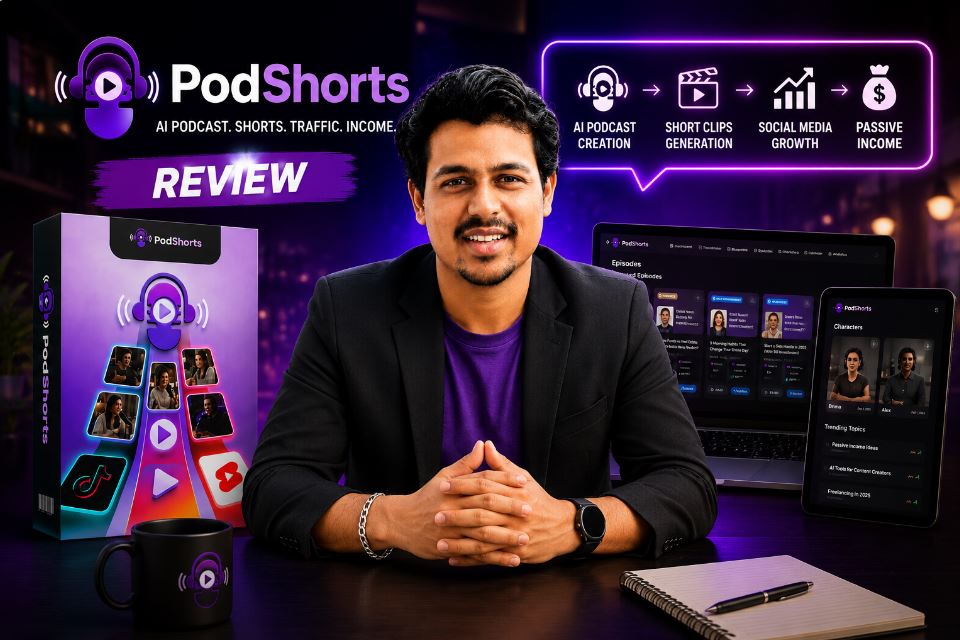
At its simplest, PodShorts is an AI-powered system designed to create podcast-style shows and turn them into short-form social media content.
You choose a niche or topic, create a consistent cast of AI hosts, and let the system generate conversations around your chosen subjects.
Those conversations can then be turned into short clips and distributed across platforms such as TikTok, Instagram and YouTube Shorts. The platform also includes features around topic discovery, captions, publishing, monetization and performance tracking.
So I wouldn’t describe PodShorts simply as an “AI podcast maker.”
It’s closer to a content production and distribution system built around a recurring show.
You Don’t Have to Become the Host
This is probably the first thing that caught my attention.
Normally, if I wanted to build a social media page around a particular niche, I’d have to become the face of that page.
That means recording myself.
Again.
And again.
And again.
But PodShorts takes a different approach.
You can use AI hosts with their own voices, personalities and speaking styles. The creator of PodShorts also describes the option to clone your own face and voice, so you can essentially create a digital version of yourself that becomes the recurring host without requiring you to record every episode.
That opens up some interesting possibilities.
Imagine building a page around personal finance with two recurring hosts.
Or a fitness page with one energetic trainer and one skeptical “myth buster.”
Or a technology page where two hosts debate new AI tools.
Or even a page around Indian startup stories, freelancing, productivity or side hustles.
The important part isn’t merely that AI is talking.
It’s that the same host or hosts can keep appearing.
That consistency can make the page feel more like a show and less like a random collection of AI-generated videos.
The Real Idea Is “One Niche, One Show”
This is how I’d personally approach PodShorts.
I wouldn’t log in and think, “Let me make some AI videos.”
I’d think:
“What kind of show can I build that people would recognize after watching several clips?”
That’s a much better question.
Suppose I choose the niche of side hustles.
My show could have two hosts who discuss different ways people can make money online.
One host could be the practical, cautious one.
The other could be the slightly crazy idea guy.
Every episode revolves around one topic.
- “Can you really make money selling digital products?”
- “Are faceless YouTube channels still worth starting?”
- “Should freelancers use AI?”
- “Can a local business pay you for social media content?”
Now you have a recurring format.
And every episode can potentially produce several short clips.
That’s where the model starts looking less like a video-generation tool and more like a small media business.
One Topic Can Feed Your Social Media Pages
This is probably my favorite part of the whole concept.
The traditional way of thinking about content is:
One idea = one post.
But a podcast-style conversation changes that.
Let’s say your AI hosts have a five-minute conversation about “5 mistakes new freelancers make.”
Inside that conversation, you may have several usable moments.
- A strong opening opinion.
- A disagreement.
- A useful tip.
- A surprising example.
- A funny exchange.
- A conclusion.
Each moment can potentially become its own short-form clip.
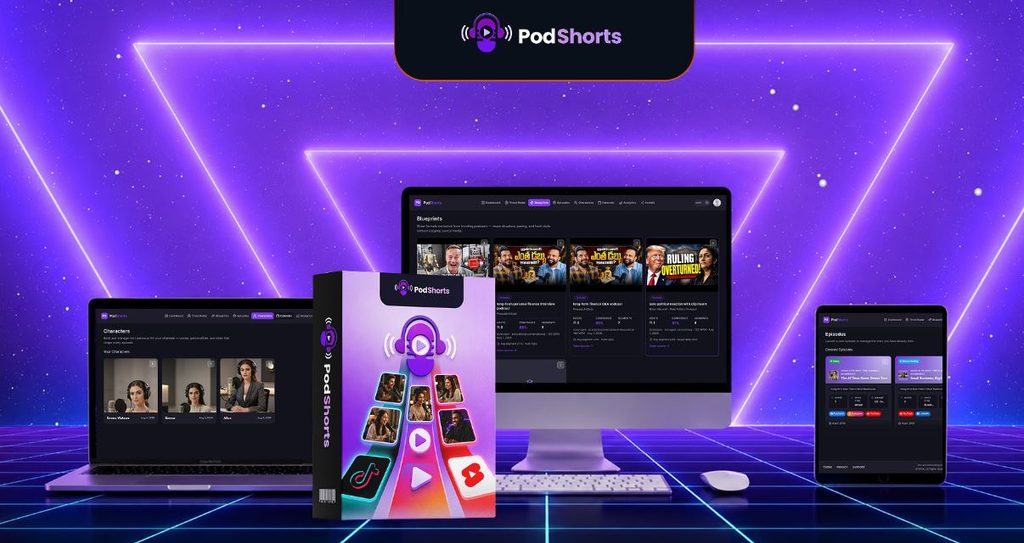
PodShorts’ ClipGenie system is designed to automatically extract short clips from episodes, add captions and prepare them for short-form distribution. Its Variation Engine then creates different versions for different platforms.
So instead of constantly sitting in front of a blank Canva or video editor wondering what to post today, you’re building a workflow where one topic can create multiple pieces of content.
For someone trying to maintain one or several social media pages, that’s a pretty useful idea.
What About Finding Topics?
This is another part I think you shouldn’t overlook.
Because creating videos isn’t the hardest part.
Knowing what to create is.
You can have the world’s fanciest AI video generator and still produce content nobody cares about.
PodShorts includes a TrendRadar feature designed to identify rising topics and formats within a niche, then generate different angles for a selected topic.
Again, I wouldn’t blindly trust any automated trend system.
I’d still use my own judgment.
But having AI help me find potential topics is certainly better than staring at my content calendar every Sunday night thinking, “What on earth am I going to post this week?”
And Then Comes the Monetization Part
Here’s where PodShorts moves beyond content creation.
The system includes a hosted monetized bio page, niche-matched offers, affiliate-link integration, offer rotation and click tracking through its ProfitRouter component.
The basic idea is pretty simple:
Content → attention → bio link → offer → commission.
Of course, that doesn’t mean every clip will generate sales.
Views aren’t money.
Followers aren’t automatically money either.
You still need a relevant offer, a good call to action and an audience that actually cares about what you’re recommending.
But at least the monetization path is considered as part of the system instead of being treated as an afterthought.
And that’s something I appreciate.
You Can Also Use It for a Client Service
Here’s another business angle I’d consider.
Suppose you don’t want to build your own social media brand.
You could potentially use this type of workflow to create content for local businesses or clients, assuming your license gives you the necessary commercial rights.
- A dentist could have a weekly educational show.
- A realtor could have a property and home-buying show.
- A fitness business could have a fitness-myths show.
- A restaurant could have a food-focused show.
The PodShorts website specifically positions its commercial-rights offering as a way to sell the content created with the platform to clients.
That’s a different way of looking at the tool.
Instead of asking:
“Can this make me viral videos?”
you could ask:
“Can this help me build a repeatable content service?”
For a freelancer or side hustler, I think the second question is much more valuable.
But Here’s Where I Think PodShorts Needs to Improve
Now for the part I don’t want to skip just because this is a positive review.
The technology still has some room to improve.
The AI hosts can create surprisingly convincing podcast-style conversations, but at times the delivery still feels a little robotic.
The voices and interactions are getting closer to natural human conversation, but we’re not completely at the point where I’d consistently forget that I’m watching AI-generated content.
Sometimes there’s a subtle artificial rhythm.
Sometimes the emotional delivery isn’t quite human.
And occasionally, you can feel that you’re watching a machine trying to imitate two people having a conversation.
That’s not necessarily a deal-breaker for me.
AI video and voice technology is improving incredibly quickly, and PodShorts is clearly trying to solve a much harder problem than simply generating a talking avatar.
But if the company can make the hosts more emotionally expressive, spontaneous and naturally conversational, that would make the entire concept considerably more powerful.
Because the whole attraction of this format is the feeling that you’re listening in on an actual conversation.
The closer it gets to genuine human chemistry, the better.
So, Who Is PodShorts Really For?
I wouldn’t recommend looking at PodShorts simply as another AI video tool.
I think it makes more sense for someone who wants to build a repeatable content property.
For example, you might be:
- A side hustler who wants to build a social media page around one niche.
- A creator who doesn’t want to show their face.
- Someone who wants a consistent AI host across hundreds of videos.
- A person who wants to experiment with multiple niche pages.
- A freelancer looking for a productized content service.
Or someone who already has affiliate offers, digital products or services and needs a steady stream of content to attract attention.
That’s where the idea starts making sense.
My Verdict: Interesting Tool, But Don’t Expect Magic
PodShorts tries to remove much of the production work standing between an idea and a published piece of content.
My biggest reservation is still the same one I mentioned earlier: the AI hosts aren’t perfectly human yet.
But if you’re willing to accept that slight robotic feel—and you’re more interested in building a consistent content system than producing Hollywood-level videos—I can see why this could be useful.
Personally, I wouldn’t buy it because I want an AI to “make money for me.”
That’s the wrong expectation.
I’d consider it if I had a niche I genuinely wanted to build around, a monetization path to connect with that niche, and the willingness to keep testing topics and improving the show.
Because ultimately, PodShorts can automate a lot of the Podcast content production.
It can’t decide whether your niche is worth building.
It can’t magically make boring topics interesting.
And it certainly can’t replace consistency and good judgment.
But if you’ve already got those parts figured out, having an AI production team sitting behind your social media page could be pretty darn interesting.
My take: PodShorts (priced at $37) is less about creating AI videos and more about building a repeatable niche-based content business—with AI doing much of the heavy lifting.