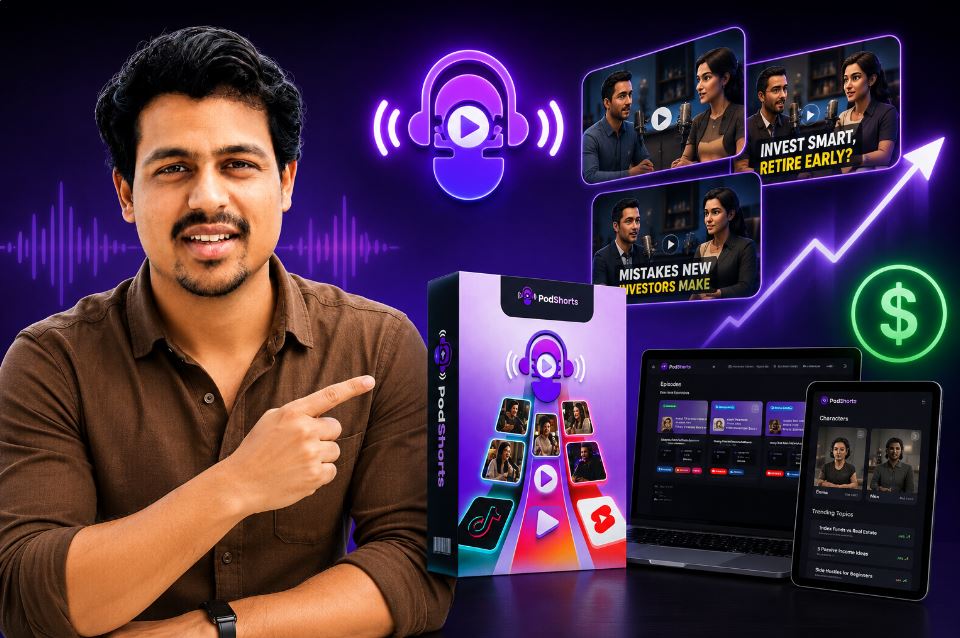

I used to think starting a podcast meant buying a microphone, finding a quiet room, recording myself for an hour, editing the conversation, creating thumbnails, and then somehow finding people who would actually listen to it.
That sounds less like a side business and more like another full-time job.
But there is a different way to look at podcasting today. Instead of thinking, “I need to become a podcaster,” you can think, “I need to build a content show around a topic people already care about.”
And with AI handling much of the production work, you don’t necessarily need to record your face, use your own voice, or spend hours editing every episode.
The real business isn’t the podcast
The podcast is only the front end.
The more interesting business model is what happens after you have something people want to watch.
Imagine you pick a niche such as personal finance. You choose two AI hosts with different personalities. One could be the cautious investor, while the other is the person who loves taking risks.
You give them a topic like “Index Funds vs Real Estate.”
Instead of writing an article and hoping someone finds it, you create a conversation around the topic.
That conversation becomes your main piece of content.
Then you break that conversation into multiple short clips that can be distributed across TikTok, Instagram and YouTube Shorts.
Suddenly, one topic isn’t just one piece of content anymore.
It’s the beginning of a small content machine.
Start with the topic, not the technology
This is where I think many people approach AI content backwards.
They open an AI tool first and start asking, “What can this thing create?”
I’d rather start with a simpler question:
“What does my audience already want to talk about?”
The PodShorts software, for example, describes a TrendRadar system that looks for rising topics and formats inside a niche, then generates multiple angles around a selected topic.
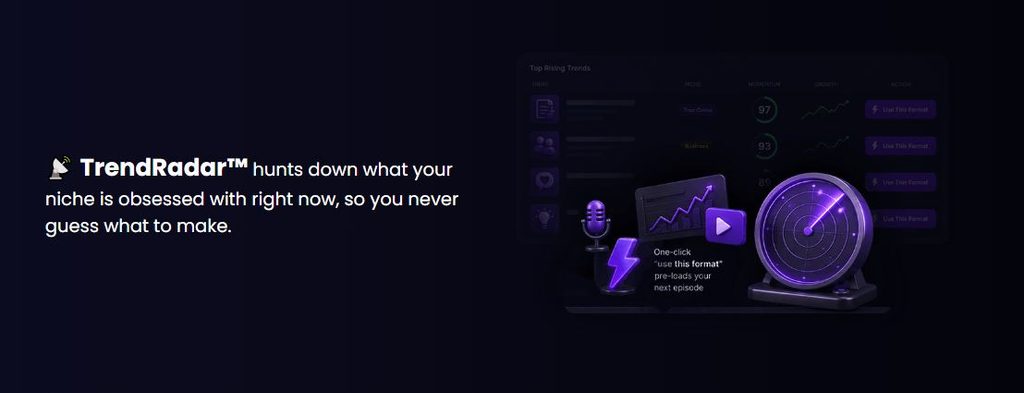
Whether you use a tool like that or research manually, the principle is useful.
Don’t create content simply because AI can create it.
Find a topic with existing curiosity, then use AI to help you turn that curiosity into content.
That’s a much healthier way to think about AI.
Give your show a personality
A generic AI voice reading an article can feel like… well, an AI voice reading an article.
A conversation is different.
Two recurring hosts can disagree, joke, challenge each other, explain things differently and develop recognizable personalities. AI hosts with distinct voices, personalities and speaking styles, along with the option of creating a consistent cast across episodes.
That consistency matters.
If someone watches three clips from your show and recognizes the same hosts each time, you’re no longer publishing random AI videos.
You’re gradually building a content brand.
And you don’t have to make yourself the brand.
That’s particularly useful if you’re camera-shy, don’t like recording your voice, or simply don’t want your personal identity attached to every piece of content you publish.
One conversation can become a lot of content
This is probably my favorite part of the model.
Let’s say your show produces a five-minute conversation about “5 mistakes new freelancers make.”
You don’t have to treat that as one five-minute video.
That conversation might contain several interesting moments:
A strong opening opinion.
A disagreement between the hosts.
One practical tip.
A surprising example.
A final takeaway.
Each of those moments can potentially become a standalone short-form clip.
The PodShorts workflow specifically describes automatically turning episodes into captioned, hook-first short clips and creating platform-specific variations for TikTok, Instagram and YouTube.
So instead of constantly asking yourself, “What should I post today?”, you’re building a system where one topic can feed several pieces of content.
That is a very different way of creating.
Now connect attention to a business
Views alone don’t automatically create a business.
You need somewhere useful to send the people who discover your content.
- Maybe that’s an affiliate offer.
- Maybe it’s your own digital product.
- Maybe it’s an email-list signup.
- Maybe it’s a service.
- Maybe it’s a local-business offer.
Let’s understand this as a simple path:
Short-form content → viewer → bio link → relevant offer → commission.
PodShorts’ ProfitRouter system is designed around a monetized bio page, niche-matched offers and click tracking.
You don’t have to copy that exact implementation.
The bigger lesson is this:
Don’t build an audience first and worry about monetization later. Think about the connection between your content and your business from the beginning.
You don’t need to become a full-time podcaster
This is probably the biggest mindset shift.
Traditional podcasting can require recording, editing, publishing, guest coordination and a lot of consistency.
A podcast-style content business can be much narrower.
You choose a niche.
You choose the personality and format of your show.
You find topics.
You create conversations.
You turn those conversations into short-form content.
Then you distribute and monetize the attention.
AI tools can now automate significant portions of that workflow. PodShorts is one example of a platform built around this particular approach, combining AI hosts, episode creation, clipping, captions, publishing and monetization features in one workflow.
But honestly, I wouldn’t make the software the main idea.
The business model is more interesting than the tool.
The simple blueprint I’d start with
If I were testing this idea from scratch, I’d keep it ridiculously simple.
- Pick one narrow niche.
- Create one recognizable show concept.
- Give it two recurring personalities.
Choose topics people already care about.
- Turn each topic into a short conversation.
- Break the conversation into multiple useful clips.
- Publish those clips consistently.
- And finally, give interested viewers one clear next step.
That’s it.
You don’t need five niches on day one. You don’t need hundreds of videos sitting in a folder. And you certainly don’t need to build a giant podcast studio in your bedroom.
The goal isn’t to use AI to produce more meaningless content.
It’s to use AI to make consistent, recognizable, useful content possible for someone who doesn’t have a production team.
And that, to me, is the more interesting opportunity hiding behind AI podcasting.
You’re not really trying to become a podcaster.
You’re building a small media business around a topic—and letting AI handle much of the production.