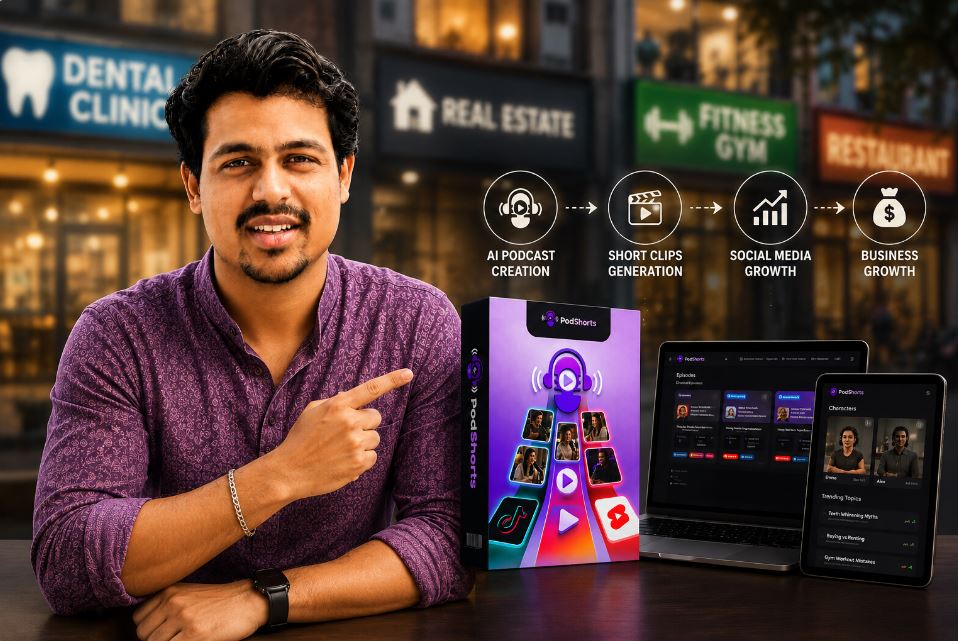

A few years ago, if a local business wanted professional video content every month, they usually had two choices: hire an agency or figure it out themselves.
Neither option was particularly friendly to a small business.
A dentist, realtor, gym owner, restaurant owner or local consultant might understand that they need short-form content, but they don’t necessarily have the time, equipment, editing skills or creative team to produce it consistently.
That gap creates an interesting opportunity for a solo freelancer.
You don’t necessarily have to become a content creator for yourself. You can become the person who creates content for local businesses.
And AI is making that service much easier to deliver.
Don’t sell AI. Sell the outcome.
This is the first thing I’d get right.
A local business owner probably doesn’t care that you have access to some fancy AI video generator. They care about getting useful content that makes their business look professional and keeps their social media active.
So instead of saying, “I can create AI-powered videos for your business,” I’d position the offer differently.
“I can create a month of short-form content for your business without requiring you to spend hours recording videos.”
That’s a much more interesting proposition.
The technology stays behind the curtain. The client sees the finished content.
Pick a business that’s already easy to demonstrate
You don’t need to approach every business in your city.
Start with businesses where you can quickly imagine a content concept.
Think about a dentist.
You could create a short podcast-style show where two hosts discuss teeth whitening, common dental mistakes, braces, oral hygiene or questions patients are too embarrassed to ask.
A gym could have hosts discussing workout myths, beginner mistakes and nutrition.
A realtor could have conversations about buying property, renting versus buying, home inspections and common mistakes first-time buyers make.
A restaurant could create short conversations around its dishes, ingredients, food combinations or local food trends.
The PodShorts softwrae itself uses examples such as dentists, realtors, gyms and restaurants to demonstrate this type of local-business service opportunity.
And that’s important because you’re not selling an abstract idea.
You can show the business owner what their content could look like.
Create a sample before asking for the sale
This is where I’d change the usual freelancer approach.
Don’t begin with a long sales pitch.
Pick one business and create a small demonstration.
Let’s say there’s a dental clinic near you called Bright Smile Dental.
You could create a sample branded podcast-style episode around:
“Does teeth whitening actually damage your teeth?”
Give the show two consistent AI hosts.
- Create a short conversation.
- Turn the interesting moments into vertical clips.
- Add the business name and visual identity.
- Then show the owner what you made.
Now you’re not saying, “Imagine what I could do for you.”
You’re saying:
“I made this for your business. Imagine having 20 more like it every month.”
That’s a much easier conversation.
One episode can become a content package
This is where the economics become interesting.
You don’t necessarily have to sell one video at a time.
A single conversation can produce several short-form clips, each with a different hook or angle. The PodShorts workflow, for example, describes creating full AI-hosted episodes and automatically turning them into captioned, hook-first clips, followed by platform-specific variations for TikTok, Instagram and YouTube.
That means your service can be packaged around monthly content production rather than individual videos.
For example, you might offer a package containing a certain number of episodes and short-form clips every month.
The exact pricing is something you’d need to determine based on your market, quality and workload. Some freelancers of a few countries charging for short-form packages and local retainers.
The bigger idea is the recurring model.
One client doesn’t have to mean one project.
It can mean monthly content revenue.
Make the content about the business, not the AI
There’s another subtle advantage here.
The business doesn’t necessarily need to put its owner in front of the camera.
An AI-hosted show can become a kind of recurring media property for the business, with consistent hosts, topics and visual identity.
That could be particularly useful for owners who say:
- “I don’t like being on camera.”
- “I don’t know what to say.”
- “I don’t have time to record.”
- “I can’t edit videos.”
Those aren’t objections anymore.
They become the reason your service exists.
You handle the production. The business owner supplies the expertise, offers, products or topics worth discussing.
Commercial rights can change the equation
There’s one detail in the PodShorts offer that I wouldn’t ignore if you’re thinking about turning this into a service business: its launch offer specifically includes a commercial-rights license, allowing buyers to sell what the system produces to clients.
That doesn’t mean every AI tool automatically gives you the right to resell its output.
Quite the opposite.
If you’re planning to build a client service around an AI tool, check the commercial-use terms before selling anything.
That’s boring paperwork, but it’s the kind of boring thing that can save you a very unfun conversation later.
Start with one client, not an agency
I wouldn’t build a giant agency website on day one.
- I’d pick one niche.
- Find five to ten local businesses.
- Create one strong sample for each.
- Show it to them.
- Try to land one paying client.
Then figure out how long the production actually takes.
Once you know the workflow, you can improve it, create templates and eventually handle more clients without increasing your workload at the same rate.
That’s where AI becomes genuinely useful.
Not because it magically creates a business for you.
Because it can help one person deliver what previously required several people: research, scripting, visual production, editing, captions and distribution.
The real opportunity is bigger than AI videos
You’re not really selling AI-generated videos.
You’re selling consistent content without the usual production headache.
And that is a much more durable service.
A local business doesn’t wake up one morning and say, “I need exactly 37 AI videos.”
It says, “I need people to notice my business.”
Your job is to build a content system that helps them show up consistently.
The AI is simply the machinery behind that system.
So if I were starting this side business today, I wouldn’t ask:
“Which AI video tool should I sell?”
I’d ask:
“Which local business can I help become more visible every week?”
Find that business, create something they can actually see, turn it into a repeatable monthly service—and let the technology do the heavy lifting behind the scenes.
That’s where this gets interesting.
You’re no longer just playing with AI.
You’re using AI to build a service a real business might actually pay you for.